Pack format and provenance · Editorial field guide
1980s Wax Packs: Identifying Year and Set From the Wrapper
Affiliate disclosure: Some marketplace links earn a commission if you buy. Listings are seller descriptions—not independent authentication or proof of value.
Quick answer. Wrapper art, manufacturer text and pack format are often stronger date clues than a vague memory of what cards looked like inside. The practical goal here is brand and checklist workflow using packaging clues, while keeping uncertain details visibly uncertain.
This guide is for someone handling specific sealed product—whether deciding what to buy, documenting a family find, or preparing a defensible sale description. The key is to investigate the exact example rather than relying on a broad category name.
What to establish first
The question: Brand and checklist workflow using packaging clues. This is more specific than “Is it rare?” or “Is it worth anything?” because it can be answered from recorded evidence. Wrapper art, manufacturer text and pack format are often stronger date clues than a vague memory of what cards looked like inside.
Before spending time on a valuation, establish which version or condition is actually involved. The practical risk is promising hidden contents, assuming any loose pack is unsearched, or confusing adjacent production years. Neither age nor an attractive seller story resolves that uncertainty.
In-depth field guide
A wax trading-card pack is a small historical package. The wrapper may tell you the manufacturer, sport, promotion, and period, but some designs were reused or issued in several closely related formats. Identification should come before any claim about a valuable card possibly inside.
Photograph the wrapper without opening it
Start with front and back images and closeups of logos, copyright notices, contest language, price markings, package weight or card count when printed, and both folded ends. Photograph the side folds and visible wear. Preserve the original wrapper and note tears, loose flaps, glue residue, or discoloration.
No single characteristic makes a pack authentic or untouched. Wrappers can be reproduced, and old packaging can be resealed. Treat the photographs as a research record rather than a verdict.
Identify the release in layers
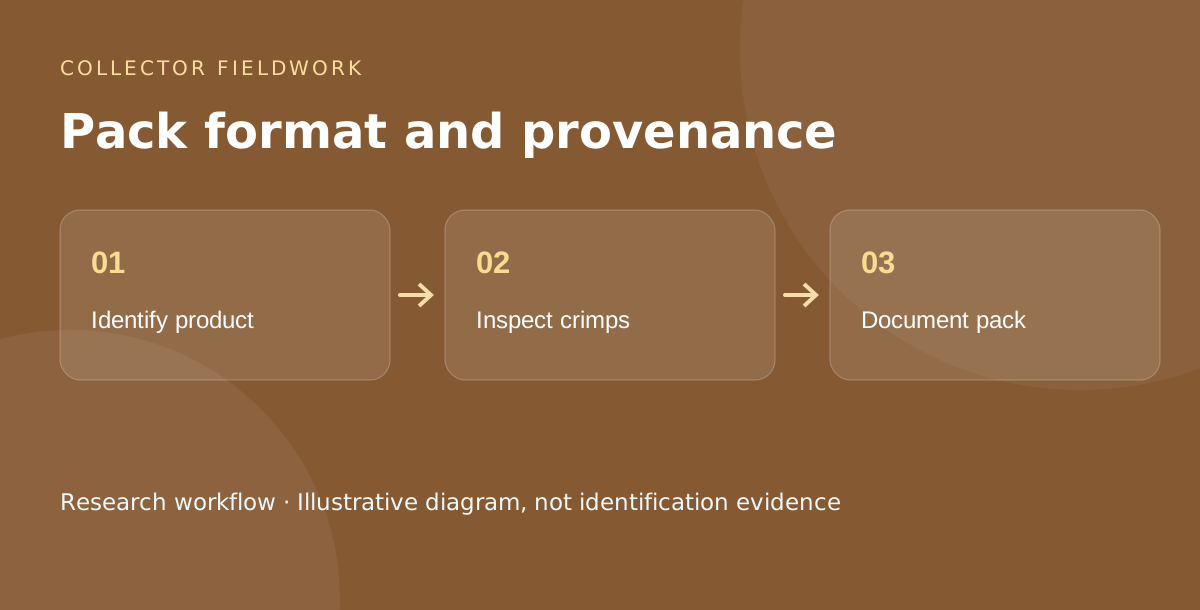
First identify the manufacturer and sport. Next narrow the probable year or set using the wrapper design, product branding, promotions, and any visible legal or copyright text. Then distinguish wax, cello, rack, blister, and related formats. A listing that mixes these categories may produce poor pricing comparisons.
Confirm the set with contemporary catalog references, manufacturer material where available, and documented collector examples. An old wrapper alone does not reveal which individual cards a pack contains. A seller's assertion that “a star rookie is inside” is not evidence unless the card is legitimately visible, and even then condition remains uncertain.
Notice the era's production context
Collectors sometimes use “junk wax” to describe periods of widespread sports-card production, but that phrase is not a substitute for exact identification. Particular issues, formats and sealed conditions can still matter. Conversely, an old-looking pack is not automatically scarce. Compare availability and actual transactions for the specific product instead of assigning an era-wide premium.
Inspect the seals without treating them as a magic test
Ask for well-lit views of the wax folds or sealed ends and note unusual adhesives, asymmetry, repairs, or torn corners. These are observations, not conclusive authentication criteria. Legitimate packs can show manufacturing irregularities and storage wear. For higher-value items, consider specialist review or recognized grading services, while remembering that certification must also be verified.
Compare prices intelligently
Use the same year, manufacturer, set and pack format in completed-sales searches. A pack graded in a holder may sell differently from a loose pack; a box-fresh example may command a premium over a visibly damaged wrapper. Avoid using active listing prices as proof of realized value. Add fees, shipping and insurance to the buyer's total cost.
Collector record template
A simple entry is enough: Brand / set / suspected year / sport / format / wrapper variant / visible markings / condition / source / photographs / identity confidence / verification next step. Confidence is useful: “likely 1987 issue, needs comparison” is better than a false absolute claim.
If buying for nostalgia, budget for the pack as a display piece, not as a promise of a star card. The moment you open it, you no longer own the same sealed collectible. That tradeoff is part of the appeal—and part of the risk.
Make the description testable
Turn each attractive adjective into an observable question. “Rare” becomes “which exact edition and how was it identified?” “Original” becomes “which components are documented?” “Works” becomes “what demonstration was performed?” “Unsearched” becomes “what part of the custody history is known?” A claim that cannot be tested belongs in the uncertainty column.
Keep a clean distinction between facts visible in photos, seller representations, third-party opinions and unresolved questions. That gives a future buyer or appraiser a way to retrace the reasoning.
The photographs or records that would settle it
Ask for front/back, crimp at both ends, sides, SKU/UPC and scale. A photograph should be useful for diagnosis rather than just flattering. Save uncropped originals and label the views consistently so a specialist can request an additional angle without losing track of the object.
For 1980s Wax Packs: Identifying Year and Set From the Wrapper, a useful listing names the scope of what the seller actually checked: brand and checklist workflow using packaging clues. An absent identification detail is different from ordinary cosmetic wear; it can change what object a buyer thinks they are purchasing. Save the seller’s answer beside your own observations.
A comparison worksheet for this exact question
| Question to resolve | Evidence to record | Decision if missing |
|---|---|---|
| Brand, release year, sport or franchise | Photograph, catalog reference, seller response or exact observation | Mark as not fully identified; defer valuation. |
| Set, language, edition and wrapper wording | Photograph, catalog reference, seller response or exact observation | Use original photo, label or third-party catalog; ask for a closeup. |
| Wax/cello/foil/blister/rack product format | Photograph, catalog reference, seller response or exact observation | Price or sell conservatively; document the uncertainty. |
| Seam/crimp and pack condition | Photograph, catalog reference, seller response or exact observation | Seek specialist review if value materially depends on it. |
An illustrative decision—not a market valuation
Suppose two examples are advertised as the same kind of collectible. One provides brand, release year, sport or franchise and set, language, edition and wrapper wording; the second uses only the broad category name and a single dramatic photo. The better-documented example is easier to research, return, insure and resell. That does not automatically mean it is worth more. It means fewer important facts are being left to imagination.
For a sealed-product purchase, compare the price of keeping the sealed object with the cost of buying individual cards you actually want. The sealed-pack versus singles worksheet does not pretend to know pull odds or pack contents.
The non-obvious part
An unopened pack is a collectible in its own right. PSA evaluates seal integrity before grading wrapper condition. It distinguishes pack authentication from any guarantee about cards hidden inside. That is why a vintage pack may be collectible even when no one plans to open it. Primary source.
Mistakes to avoid and a safe stopping point
The main trap in this category is promising hidden contents, assuming any loose pack is unsearched, or confusing adjacent production years. Before a purchase or alteration, confirm: (1) the identity, (2) physical condition, (3) documentation, and (4) the financial or legal consequence of being wrong. If any one of those is material but cannot be checked, ask for evidence or decline the transaction.
Editorial accuracy boundary: Verify exact packaging and market. This is a verification requirement, not an assertion that the item under discussion has passed inspection. No unseen object is authenticated, appraised or certified by this guide.
Seller question you can copy into a message
I am researching 1980s wax packs: identifying year and set from the wrapper. Could you show brand, release year, sport or franchise and explain brand and checklist workflow using packaging clues? Please distinguish what you checked personally from what came from a previous owner or grading label. I would also appreciate your return terms if the identification is incorrect.
The answer should create something you can verify, not merely a reassuring adjective. If a seller gives a precise limitation (for example, “I have not tested specific sealed product”), record that limitation exactly. It may be honest and useful without proving the condition you need.
Practical questions readers ask
What matters most for 1980s wax packs: identifying year and set from the wrapper?
The first test is brand, release year, sport or franchise, followed by set, language, edition and wrapper wording. Those details let you narrow the object down before anyone starts guessing a premium.
What if the listing has too few pictures?
Request an uncropped view that resolves the missing identifying mark or condition question. You can save the listing for later, but do not use its price as a comparable until you know the versions actually match.
Should I repair, clean, open or alter it before asking an expert?
Usually document first. An alteration can remove provenance or condition evidence; fragile items and high-value pieces merit qualified advice. The right treatment depends on material and condition rather than an all-purpose cleaning hack.
Marketplace research after identification
Disclosure: We may earn a commission if you purchase through this eBay link. This does not affect the identification steps or any conclusion above.
Browse relevant eBay listings to inspect — search for “1980s baseball wax packs.” This is a live search, not a verified offer or completed-sale price. Check the actual listing, seller, legality where relevant, and return terms. For valuations, separately review genuinely comparable sold transactions.
References, research limits and related reading
PSA unopened pack grading terms — official or specialist guidance, not a certificate for the item in this article.
PSA certificate verification and security note — certification-number lookups do not eliminate counterfeit risk.
Companion guides in this package (publish these routes together):
- The “Junk Wax” Label: Why 1990s Packs Still Need Identification
- Non-Sports Trading Card Packs: Movie and TV Release Clues
- Sports Pack Search Terms That Find the Wrong Year
Collection and buyer education, not individualized appraisal, authentication, legal or investment advice. We have not physically inspected the collectibles described. Affiliate transactions should be independently verified before publication.